All products are independently selected by our editors. If you buy something, we may earn an affiliate commission. Learn More >
Most people frame the glass vs. thermal carafe debate around one thing: which one keeps coffee hot longer.
I get it. Temperature matters.
But after more than two decades working in commercial kitchens and coffee establishments, I’d argue you’re asking the wrong question.
The better question is what happens to your coffee’s flavour while it sits there waiting for you.
That shifts the whole conversation.
How Each Type of Carafe Keeps Your Coffee Hot
The two types work in completely different ways, and understanding that difference is where people get confused.
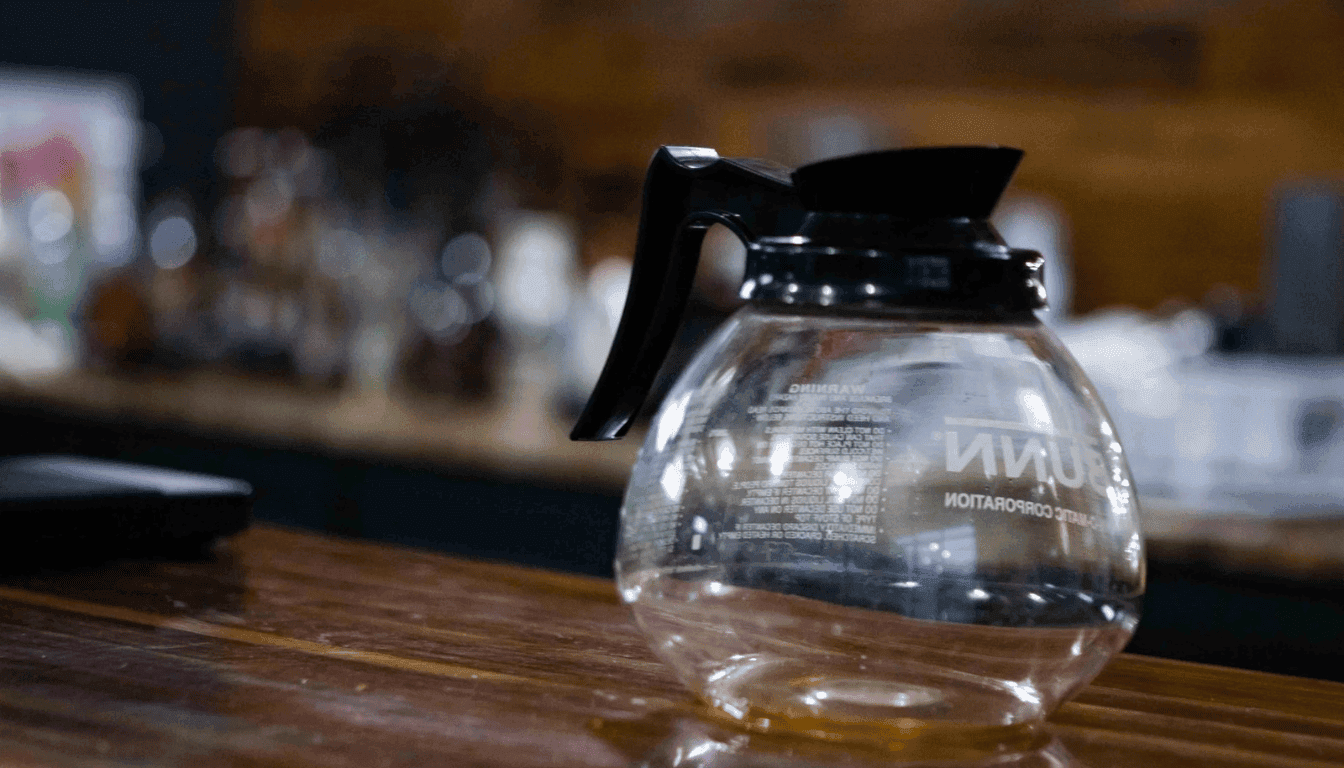
A glass carafe sits on a hotplate built into your coffee maker. The hotplate cycles on and off to maintain temperature, which sounds fine in theory. In practice, it’s slowly cooking your coffee.
Heat drives off the volatile aromatic compounds that give a good brew its complexity. It also accelerates oxidation, which turns those oils bitter and can lead to a burnt taste.
That’s where the burnt coffee taste comes from. It’s not your imagination, and it’s not your beans. It’s the hotplate under a glass carafe doing what hotplates do.
A thermal carafe works differently.
It uses double-walled stainless steel construction with a vacuum between the walls to cut off heat transfer almost entirely. There’s no external heat source at all.
Once the coffee is inside and the lid is sealed, the insulation handles everything.
The coffee doesn’t cook. It just holds at the temperature it brewed at, losing heat slowly and naturally over time rather than being subjected to a continuous low-level heat source.
What the Temperature Data Actually Tells You
Here’s the Part that Surprises Most People. Consumer Reports Coffee Maker Tests found that a glass carafe on a hotplate loses only about 2.5°f after an hour. A thermal carafe, with no heat source at all, loses around 4°f over the same period.
By the numbers, the glass carafe wins on temperature retention in the short term.
And yet thermal carafes consistently produce better-tasting coffee at the one-hour mark. That seems contradictory until you understand the hotplate problem.
It isn’t the heat loss that ruins drip coffee. It’s the continuous low-level cooking. The hot plate keeps the liquid hot for hours, but it keeps working on the chemistry of the brew the entire time.
A thermal carafe lets the coffee stay closer to exactly as it was when it brewed.
The coffee stays truer to its original flavour profile, just a few degrees cooler.
The Glass-Lined Thermal Carafe: The Option Nobody Talks About
If you’ve held off on buying a thermal carafe model because you’ve heard complaints about a metallic aftertaste, this is worth knowing.
Some thermal carafes use a glass interior rather than bare stainless steel on the inside. Brands like Bonavita and certain Zojirushi Fresh Brew Plus models offer this design.

You get the vacuum insulation and double-walled heat retention of a proper thermal unit, without any direct contact between the coffee and metal.
The result is a glass coffee carafe experience in terms of taste neutrality, with the heat retention of an insulated thermal carafe.
It’s a genuine middle ground in the glass or thermal carafe decision, and almost no article bothers to mention it.
If taste sensitivity is your reason for sticking with glass carafes, look at this option before writing thermal off entirely.
Your Drinking Window Decides Everything
If you brew a 12-cup pot and your household drains it within 30 to 40 minutes, a glass carafe on a hotplate is perfectly fine.
You’re drinking the coffee before the hotplate has much time to damage it, and you can see the level at a glance. The lower cost and easy cleaning are real advantages when the flavour trade-off barely applies to how you actually use it.
If you brew a pot and sip it across two hours or more, a thermal carafe is the clear choice.
By the time you’re pouring your third cup from a glass carafe sitting on a hotplate, the coffee has changed in ways that are hard to ignore.
A thermal carafe keeps that pot tasting far closer to how it brewed, even after a longer period.
The Technivorm Moccamaster is a good reference point here.

It’s one of the best coffee makers on the market, and it comes in both glass and thermal carafe versions. The machine itself is identical across both. The only difference is the carafe, and that choice comes down entirely to how you drink your coffee.
Technivorm understood that different coffee drinkers need different things, and that says a lot about where the real decision sits.
The Practical Trade-Offs: Cleaning, Pouring, And Cost
A thermal carafe wins on flavour and long-term heat retention, but it comes with honest pros and cons worth knowing before you buy.
Cleaning is the main friction point.
The narrow opening on most thermal carafes makes them harder to scrub out. Glass carafes go straight in the dishwasher. If that matters to your morning routine, factor it in.
Some thermal carafe models are heavier and can dribble coffee when you pour. It’s not universal, but worth checking user reviews on any specific model before buying.
Here’s a quick breakdown of how glass and thermal drip coffee makers compare across the factors that actually affect daily use:
| Factor | Glass carafe | Thermal carafe |
|---|---|---|
| Flavour over time | Degrades on hotplate | Stays closer to fresh |
| Heat retention (1 hr) | Strong with hotplate | Slight drop, no cooking |
| Cleaning | Dishwasher-friendly | Harder, narrow opening |
| Durability | Breaks if dropped | Built to last |
| Cost | Lower upfront | Higher upfront, longer lifespan |
| Coffee visibility | See the level easily | Opaque, no visibility |
| Pouring | Generally smooth | Can dribble on some models |
On cost, brewers with thermal carafes are often more expensive upfront compared to a standard glass decanter. But glass carafes break.
If you’ve ever cracked one on the edge of the sink, you know how quickly that equation shifts. A quality insulated thermal carafe outlasts several glass replacements without much effort.
One practical tip before serving coffee: Rinse your thermal carafe with hot water before you brew. It pre-heats the walls, reduces initial heat loss, and improves coffee quality across the whole pot.
Standard practice in any commercial kitchen, and just as useful at home for keeping a pot of coffee warm.


So, Is a Thermal Carafe Better than Glass?
For most coffee drinkers who aren’t emptying a pot in one sitting, yes. Thermal carafes and glass carafes both keep coffee hot, but only one of them does it without altering what your coffee tastes like.
Over any meaningful stretch of time, that difference is real.
But “better” is always conditional.
If you brew fast and drink faster, a glass carafe is cheaper, easier to clean, and lets you see exactly how much is left. That’s a legitimate choice for the right household.
What I’d push back on is the idea that a hotplate is just a warming device. It isn’t. It’s a continuous heat source applied to something that was at its best the moment it finished brewing.
Whether that matters depends entirely on how long your pot sits before the last cup is poured.
Know your drinking window. The right carafe becomes obvious from there.