All products are independently selected by our editors. If you buy something, we may earn an affiliate commission. Learn More >
If you’ve spent any time in the pour-over coffee world, you’ve come across this debate. The Hario V60 vs Kalita Wave comparison is one of those conversations that never really ends, because both drippers make genuinely great coffee.
But they do it in very different ways, and that difference matters depending on who’s doing the brewing.
I’ve used both for years, and I’m going to give you a straight answer.
Two Pour-Over Icons, Two Different Philosophies
These two brewers, the V60 and the Kalita Wave, come from the same country, compete in the same space, and yet represent almost opposite ideas about what pour-over coffee should feel like as an experience.
The Hario V60 rewards patience and skill. The Kalita Wave is built for reliability.
Understanding that core difference is the key to choosing the right one for your kitchen.
How They’re Built and Why It Matters
The V60 is a cone-shaped coffee dripper with a single large hole at the bottom and a spiral rib running up the inside walls.
Those ribs create space between the filter and the dripper, which lets air escape freely and gives water a faster, less restricted path through the coffee bed.
The result is a high flow rate that you have to actively manage.
The Kalita Wave takes a different approach. It has a flat bottom with three small holes instead of one large hole, and a crimped wave filter that reduces contact between the paper and the dripper walls.
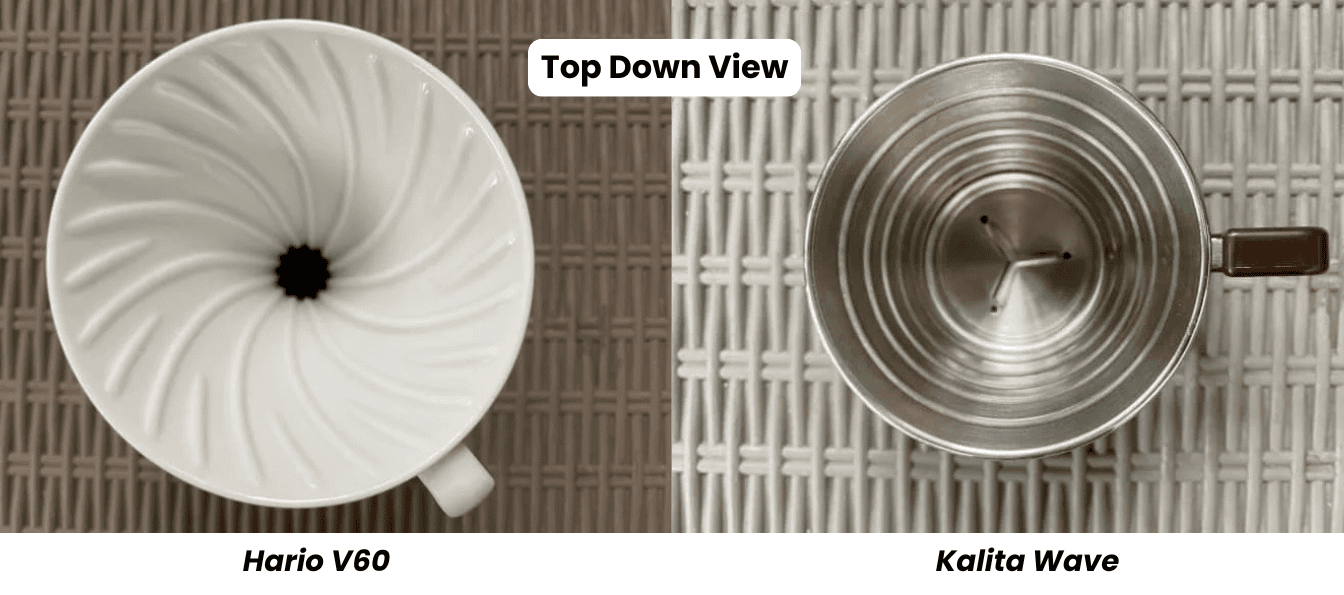
That flat brew bed means water travels the same distance through all the coffee grounds before it exits, which promotes even extraction across the entire coffee bed rather than pulling more from the centre and less from the edges.
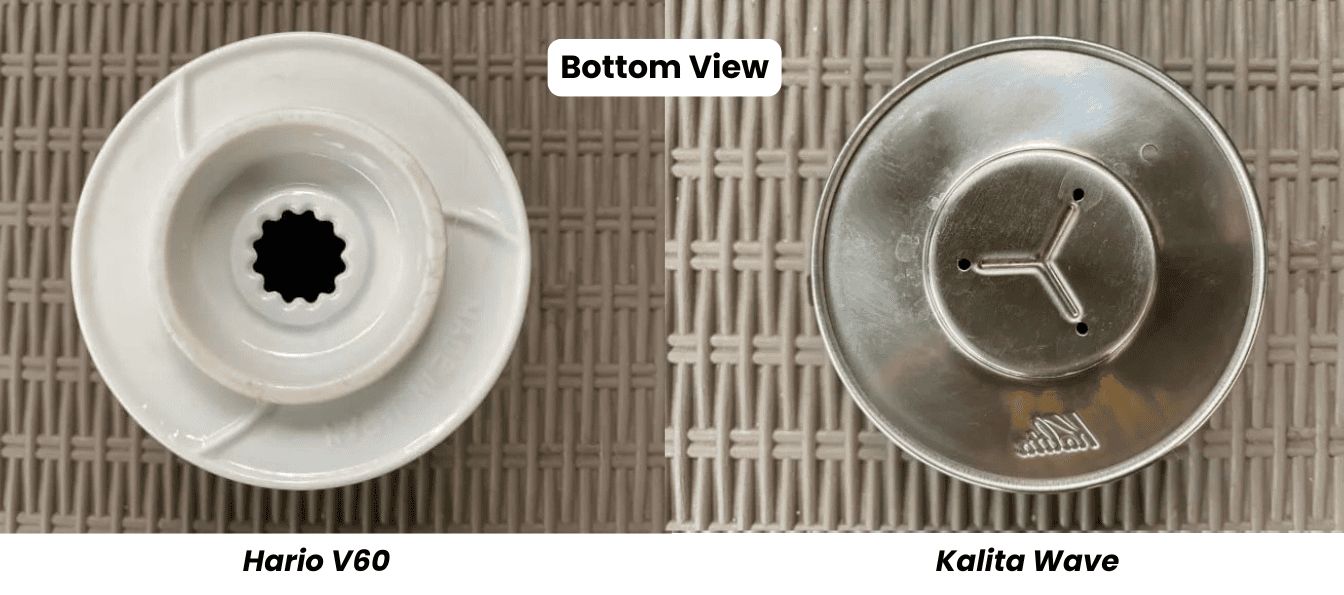
One large hole versus three smaller holes isn’t just a design quirk. It changes everything about how you brew.
The Brewing Experience: Control vs. Consistency
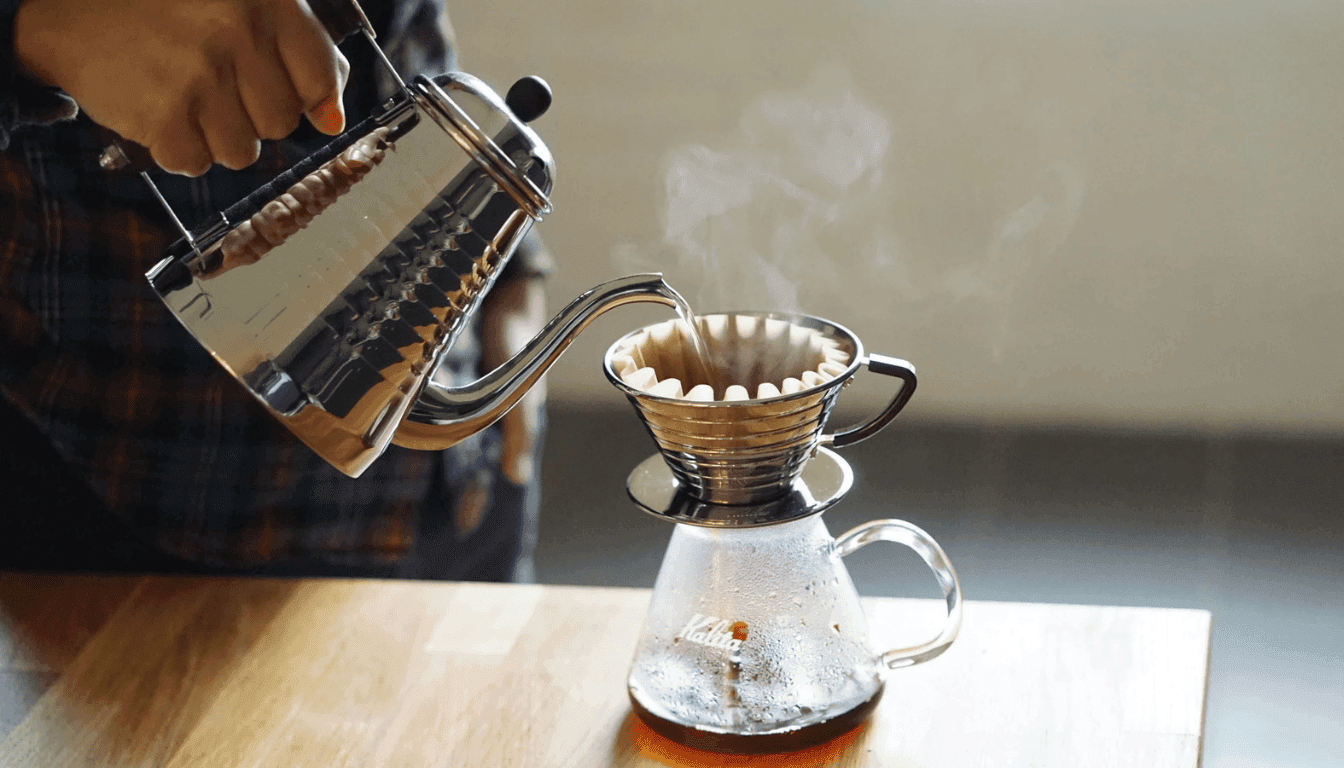
When you brew on the V60, your pouring technique is everything. The speed of your pour, the direction, the height of your gooseneck kettle spout, how many pours you do – all of it feeds directly into the extraction.
Pour too fast and the water rushes through without fully extracting the coffee. Pour too slow and you risk over-extracting and getting bitterness.
The V60 gives you full control, which is exciting when you know what you’re doing and frustrating when you don’t.
The Kalita Wave is more forgiving, and that word gets thrown around a lot without anyone explaining why.
It’s forgiving because the three holes restrict water flow, which means even if your pour isn’t perfect, the water still spends enough time in contact with the coffee grounds to extract properly during the brewing process.
There’s more room for error.
You can pour with slightly less precision and still end up with a great cup of coffee.
The stainless steel version of the Kalita Wave has a known tendency to clog, particularly with finer grind sizes. If the wave filters sit flat against the metal and block the three holes, the brew slows dramatically and can lead to over-extraction.
Worth knowing before you buy.
What’s in the Cup
The design difference between these two drippers shows up directly in the cup, and it’s worth understanding exactly how.
With the V60, you typically get a brighter, lighter-bodied cup with more pronounced acidity and clarity. When you nail the technique, the flavours feel distinct and clean.
It’s the kind of cup that showcases origin character really well – floral notes, citrus acidity, delicate sweetness. That’s why so many specialty coffee roasters and baristas reach for it when they want to highlight a specific bean.
The Kalita Wave produces a cup with a bit more body and a slightly softer flavour profile. The flat bottom and restricted flow encourage even extraction, which rounds out the acidity and gives you a balanced, clean cup of coffee using the pour over method.
It’s not dull – far from it – but it’s more approachable and consistent rather than sharp and expressive.
If you’re brewing light roasts with complex origin characteristics, the V60 is going to let those flavours sing.
If you’re working with medium roasts and want a reliable, full-tasting cup every morning, the Kalita Wave delivers that without demanding much from you technically.
Grind Size, Water Temperature, and Flow Rate
These variables behave differently depending on which brewer you’re using.
With the V60, grind size is your primary lever for controlling the brew. A finer grind slows the flow rate through that single large hole and extends contact time.
A coarser grind does the opposite. You’re using your grinder to compensate for what the brewer doesn’t restrict on its own. Medium-fine is the typical starting point, but you’ll dial it based on taste.
With the Kalita Wave dripper, the three holes already restrict flow, so grind size has less dramatic impact on brew time. You have a bit more freedom here.
Medium-coarse works well and gives you a clean extraction without pushing too much resistance against an already slower drip.
Water temperature matters for both, but particularly for the V60. Because the water flow is faster and less controlled, water that’s too cool can under-extract before it even passes through the coffee bed. Aim for 93–96°C.
The Kalita is slightly more tolerant of temperature variation because the slower flow rate gives coffee extraction more time to happen regardless.
A gooseneck kettle is non-negotiable for the V60. For the Kalita, it’s still worth using, but the restricted flow means a standard kettle won’t ruin your cup the way it might on a V60.


Materials, Sizes, and the Filter Question
Both drippers come in multiple materials, and the choice affects more than aesthetics.
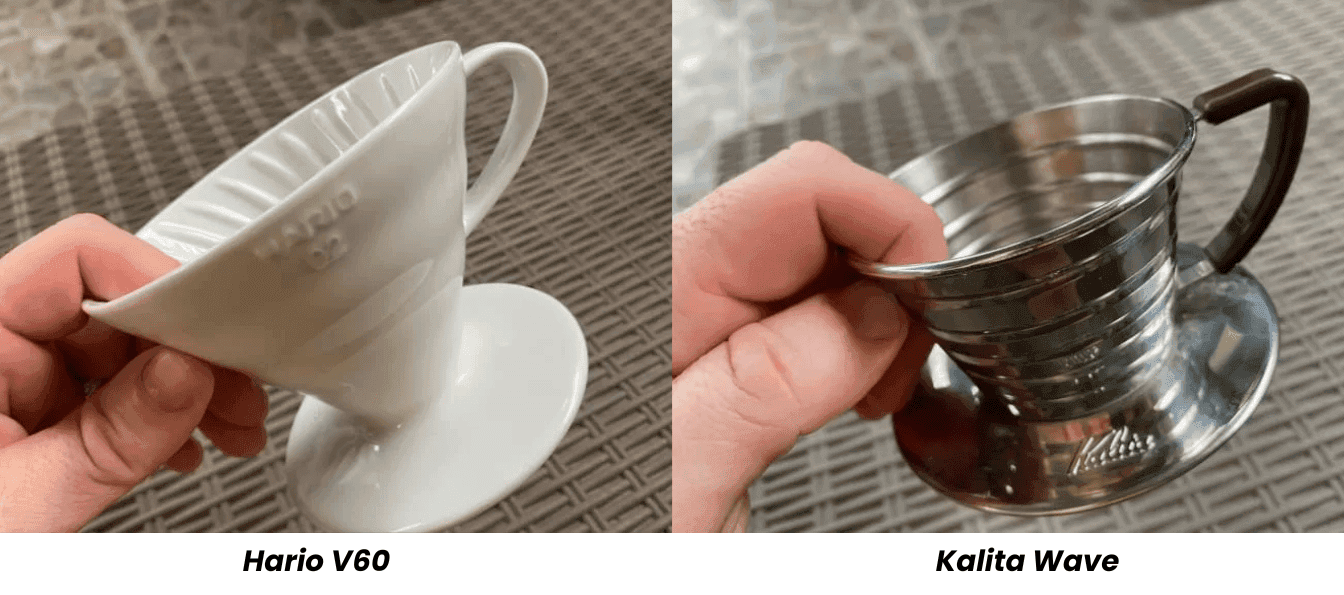
The V60 is available in plastic, ceramic, glass, stainless steel, and copper.
The plastic V60 is an excellent choice – it’s lightweight, durable, and retains heat better than you’d expect because it doesn’t absorb heat from your brew water the way ceramic and metal do.
Ceramic and metal versions look beautiful and hold heat well, but they need a proper pre-heat rinse to avoid your brew temperature dropping mid-pour.
The Kalita Wave comes in glass, ceramic, and stainless steel. The ceramic and metal versions are the most popular.
If you’re new to pour-over brewing, avoid the stainless steel version – that clogging issue makes it a harder brewer to learn on.
On size: the Kalita Wave 185 is the one most people want, designed for larger cups and typically brewing 16 to 26 ounces of coffee.
The smaller 155 is a single-cup brewer and harder to find. The V60 comes in three sizes — 01 for one cup, 02 for one to four cups, and 03 for larger batches. The 02 is the standard.
Both the V60 and Kalita Wave use proprietary filter paper, and neither is widely available in supermarkets. V60 filters are conical; wave filters have a distinctive pleated design.
You’ll be ordering both online regularly, so factor that in.
The Kalita-branded wave filters in particular are important – cheaper alternatives don’t always sit correctly in the dripper, which affects the whole brew.
SO, Which One Should You Buy?
Here’s a quick side-by-side breakdown before I give you my recommendation.
| Detail | Hario V60 | Kalita Wave |
|---|---|---|
| Best for | Experienced brewers, light roasts, flavour clarity | Beginners, medium roasts, consistent daily brewing |
| Skill level | Intermediate to advanced | Beginner to intermediate |
| Cup profile | Bright, light-bodied, high clarity | Balanced, slightly fuller body, clean |
| Flow rate | Fast – you control it | Restricted – the brewer controls it |
| Grind size | Medium-fine | Medium-coarse |
| Materials | Plastic, ceramic, glass, metal, copper | Glass, ceramic, stainless steel |
| Filter availability | Specialty stores and online | Specialty stores and online |
If you’re getting into pour-over coffee for the first time, the Kalita Wave is the better starting point.
The slower flow rate and flat brew bed do a lot of the heavy lifting for you. You’ll make good coffee quickly without needing to obsess over technique from day one.
If you already brew pour overs regularly and want more control over your cup, or if you’re working with high-quality specialty coffee beans and want to extract every nuance from them, the V60 is worth the learning curve.
Once it clicks, it’s one of the most satisfying coffee brewing experiences you’ll have at home.
If you already own one and are thinking about adding the other, there’s a strong case for it. The V60 and Kalita Wave complement each other well – different moods, different roasts, different mornings.

![Kalita Wave Series Wave Dripper 155# 04021 [1-2 Person] (Japan...](https://m.media-amazon.com/images/I/41rYA1WjHsL.jpg)
Final Thoughts
The Hario V60 vs Kalita Wave debate doesn’t have one universal right answer, but it does have the right answer for you.
The V60 gives you expressive, high-clarity coffee when you’ve got the technique dialled in. The Kalita Wave gives you consistent, clean, well-balanced coffee without demanding that you earn it first.
Both are excellent pour over brewers. Both are worth owning.
But knowing which one fits your brewing style today will save you from a frustrating few weeks of learning the hard way.