All products are independently selected by our editors. If you buy something, we may earn an affiliate commission. Learn More >
You pull a shot and it runs in 18 seconds, sour and thin. Bump the grinder one click finer and now it chokes the machine at 45 seconds, tasting like a burnt tire.
Somewhere between those two clicks is the shot you actually want, and your grinder just told you it doesn’t do “in between.”
I’ve ground on both types for over two decades behind various bars, and the usual answer to this question, “stepless for espresso, stepped for everything else,” skips the part that actually matters: how big is one step, and does that gap matter for what you brew.
Let’s take a closer look.
What Stepped and Stepless Actually Mean
Before we get into the stuff that matters, here are some quick definitions so we’re on the same page.
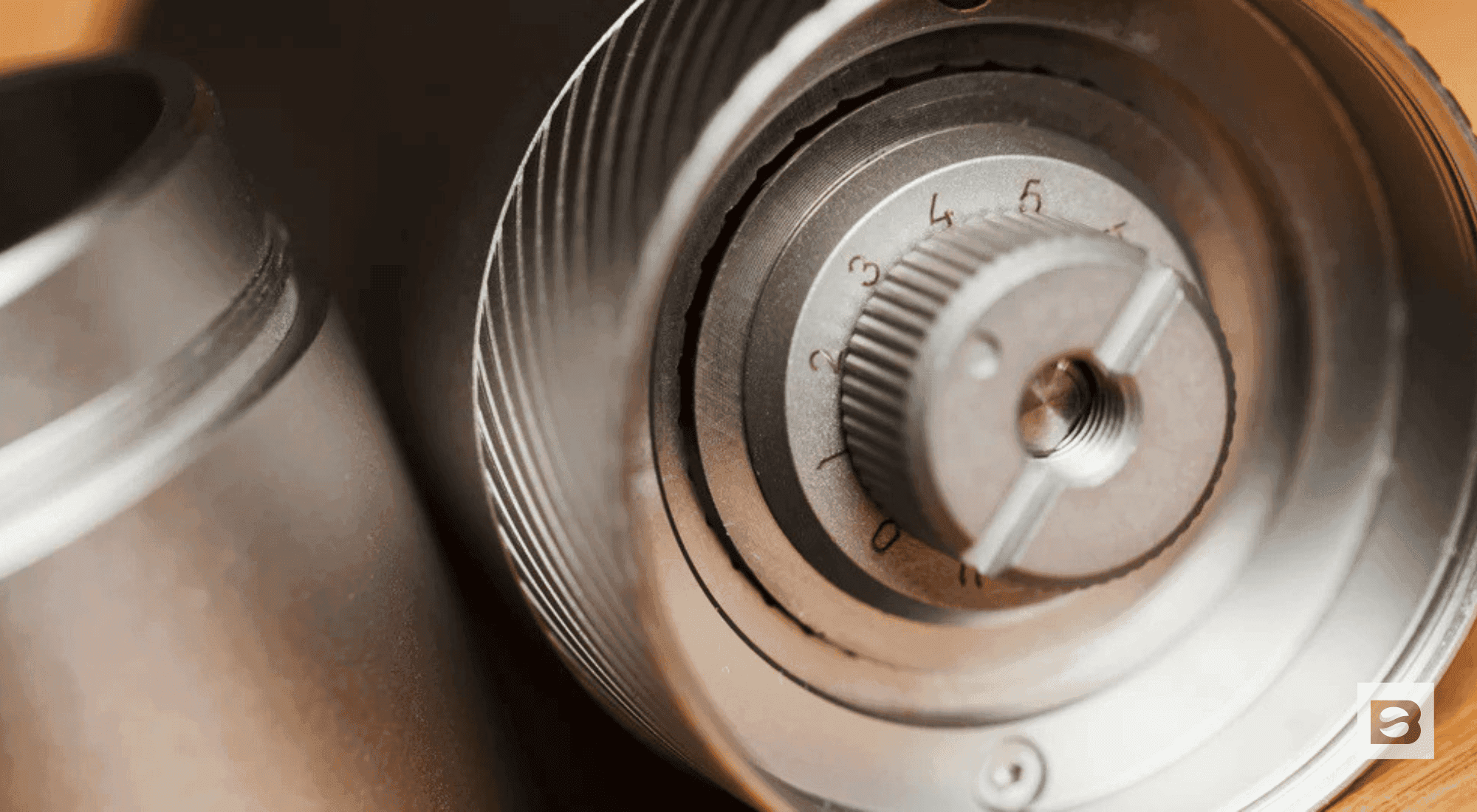
A stepped grinder locks into fixed positions. Turn the dial or collar and it clicks into a notch, usually held in place by a spring-loaded ball bearing dropping into a groove. You can’t land between two notches. That’s the whole mechanism.
A stepless grinder has no notches at all. The burrs move closer or farther apart along a threaded collar, so you can stop the adjustment anywhere along that path.
There’s no click to feel and no gate to lock into. It’s a smooth ramp instead of a staircase.
Step Size Is Not Standard
People talk about “stepped” like it’s one universal thing, when a step on a $150 grinder and a step on a well-machined $600 grinder can be worlds apart.
On a cheap stepped grinder, one click can shift the burr gap by a lot, roughly enough to knock a grind out of the espresso range and into pour-over territory in a single move.
On a nicer stepped grinder, that same click tends to be far tighter, small enough that most people brewing at home will never actually feel the gap between settings.
So the real question isn’t “stepped or stepless.” It’s “how coarse is one step on the machine I’m looking at.” A cheap stepped grinder is going to frustrate an espresso drinker.
A well-built one might not. That distinction matters far more than the stepped-or-stepless label by itself.

How To Tell If Your Steps Are Actually A Problem
You don’t need a lab to figure this out. You need a timer and two shots.
Pull a shot at your current setting and time it, start to finish.
Now move exactly one click finer, keep your dose and everything else the same, and pull again. If that single click swings your shot time by several seconds or more, your steps are too coarse for dialing in espresso precisely.
If the two shots land close to each other in time, your stepped grinder’s steps are fine enough that stepless wouldn’t actually buy you much.
This is the test I wish more people ran before spending extra money chasing stepless. A lot of home baristas assume they need infinite adjustment when what they actually need is a grinder with tighter steps.
Not every stepped grinder is the coarse kind.
The Dosing Workaround, Properly Explained
Adjusting your dose is a quick fix for being stuck between two clicks, but the part that usually gets skipped is why it works and where it stops working.
More coffee in the basket means more resistance for water to push through, which slows your shot down. Less coffee means less resistance and a faster shot.
So if click 6 runs too fast and click 7 chokes the machine, you can sometimes split the difference by staying on click 6 and adding half a gram of coffee to slow the shot toward your target time.
The catch is that dose changes the strength and body of your shot too, not just the speed.
You’re not getting the same result as a true grind change, you’re getting a workaround that trades one variable for another.
It’ll get you closer on a rough day, but if you find yourself doing this constantly, that’s your grinder telling you its steps are too far apart for what you’re asking it to do.


Hybrid Grinders: The Middle Path
A newer category worth knowing about is the dual adjustment grinder, sometimes called macro and micro adjustment.
These give you a stepped collar for big jumps between brew methods, plus a second stepless ring layered on top for fine tuning within that range.
Think of it as a stepped grinder with a stepless zoom lens built in. You get the fast, repeatable jump from French press to espresso using the macro steps, then you fine-tune the actual extraction using the micro ring without losing your place.
If you brew multiple methods and also care about nailing espresso precisely, this is worth putting on your shortlist before you assume you have to pick a side.
The Headache With Stepless Grinders: Losing Zero
Stepless grinders get sold as the precision upgrade, and they are, but they come with a quirk that catches a lot of people off guard.
Because there are no notches, there’s nothing physically stopping you from losing track of exactly where your burrs are. Clean your grinder, swap burrs, or just bump the collar hard enough, and your reference point for “zero” can drift.
Losing zero means your old numbers on the collar no longer mean what they used to, and you’re recalibrating from scratch.
The fix is simple but almost nobody sets it up in advance.
Find your true zero point by slowly closing the burrs until they just barely touch, listening for the faint scraping sound, then mark that exact position on the collar with a paint pen or a strip of tape before you ever start grinding.
Every setting you dial in after that gets logged as a number of rotations or a distance from that mark, not just a vague memory of “about here.”
That one habit saves you from re-dialing in from scratch every time something bumps your collar.

The Actual Rule For Choosing
Skip the vague “it depends on your brewing style” answer. Here’s the real decision tree.
If you drink espresso daily and nothing else, buy stepless, and mark your zero point on day one. If you bounce between pour-over, French press, and drip and rarely or never touch espresso, buy stepped, and don’t overthink it further.
If you do both regularly, look hard at a hybrid grinder with macro and micro adjustment before you assume you need to compromise.
And if you already own a stepped grinder and aren’t sure it’s holding you back, run the two-click timer test before you spend money solving a problem you might not actually have.
Final Thoughts
Stepped versus stepless isn’t really a battle between two camps. It’s a question of whether the gap between your grinder’s settings is small enough for what you’re brewing, and most people never stop to check.
Run the timer test, mark your zero if you go stepless, and don’t let a vague “espresso needs stepless” rule talk you into a purchase your current grinder might already be capable of.
What are you running right now, stepped or stepless, and is it actually giving you trouble or have you just heard you’re supposed to want the other one?